What's new
For earlier releases (June 2022 to September 2025), see the release archive.
November 2026
LatestNewRecurring orders
Your customers can now set an order to repeat on a schedule: weekly, every 2 weeks or monthly. They turn on Recurring Order on the Review & Pay step of the checkout, name it and pick the date of the first repeat. The order they're placing goes through as normal, and SparkLayer places each repeat for them, with the same products, addresses and payment method.
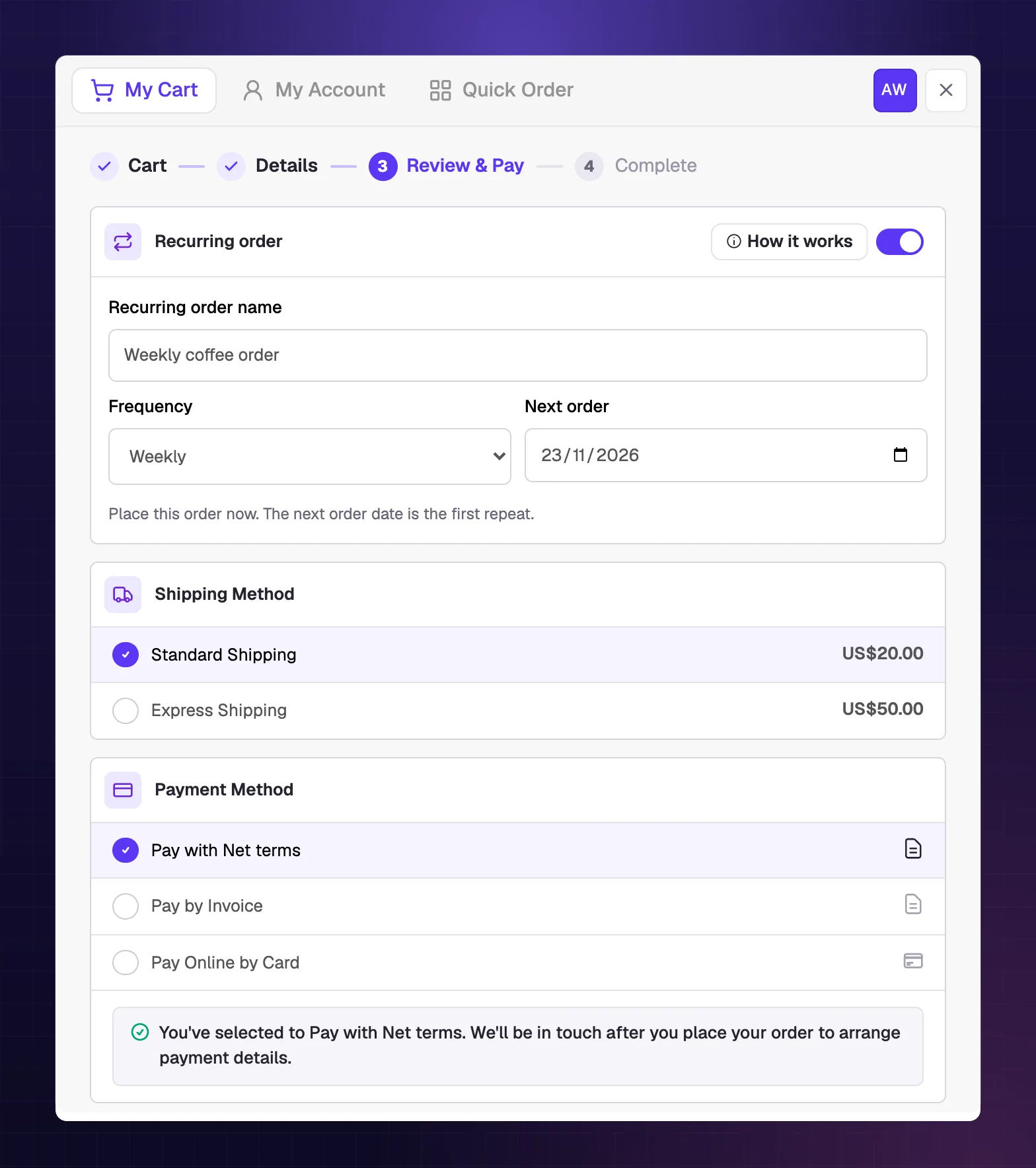
- Check each order before it's placed. A few days before each date, SparkLayer creates a scheduled order at the customer's current prices and emails them. Until its date, they can change it, or place it early.
- Manage it from My Account. Customers edit, pause, resume or delete their recurring orders in My Account > Recurring Orders. Sales reps can do the same when ordering for them.
- Stay in control. Turn on Recurring orders at Settings,Configurations,Ordering (opens in your SparkLayer Dashboard in a new tab), choose how many days customers get to check each order, between 3 and 7, and turn recurring orders off for any customer group that shouldn't have them.
Recurring orders are on the Growth plan and above. See Set up recurring orders and Manage recurring orders.
NewSparkLayer in Claude's connector directory

SparkLayer is now in Claude's connector directory (opens in a new tab), so you can connect Claude to your store in a couple of clicks, with no server address to copy. Open SparkLayer's page in the directory, or search for it at Customize > Connectors in Claude, and click Connect. Then sign in to SparkLayer, choose your stores and pick Live or Test for each. On Claude's Team and Enterprise plans, an Owner adds SparkLayer for everyone first. See SparkLayer MCP.
NewOutreach in Pulse
The Task List in Pulse is now Outreach: one place to plan your day, work through lists of companies and see what your outreach turned into. Open it from Outreach in the Pulse sidebar. Its badge counts tasks due today or overdue, and customers waiting on your reply.
- Today's queue suggests up to 6 companies most worth contacting today, with the reason, such as a reply waiting, an overdue reorder or an account that's gone quiet. Add them to your Outreach plan, read the prep sheet before you call or visit, then log how it went.
- Worklist holds your team's lists of companies, such as a call list or a win-back push. Start one from a suggested list, such as Due a reorder, Going quiet or Owe you money, or click Build call list in Companies for up to 20 of your biggest accounts at risk. Move each company from To contact to Contacted, Engaged and Done, and set a follow-up date as you go. Every move is logged on the company's timeline.
- Reports, under Worklist, show the last 10 weeks of outreach: the companies you worked and reached, and how many ordered afterwards.
- Review list is your own list of companies to come back to. Pin a company from its menu, and drag the list into the order you want.
- All tasks holds every follow-up you've promised, as a list or on a calendar, and Messages collects the customers waiting on your reply.
See Outreach.
NewTargets in Pulse
Pulse now tracks the month against your targets. Turn on Targets at Storefront,Options,Pulse (opens in your SparkLayer Dashboard in a new tab) (Core Script version 5.0.34 or later), and Targets appears in the Pulse sidebar.
- A target for the store. Set a monthly target for GMV, orders, active buyers or average order value, and see where the month is heading at its current pace.
- A target for each category. Each product category gets its own target, with a suggestion from its last 3 months. Each shows Ahead, On pace or Behind, and how much it needs a day to catch up.
- A target for each rep. Split a category's target between your reps by their share of it, or give a rep a target for their whole business. Reps see their own targets on their Overview.
- Plan the months ahead. Give any month its own target, or grow the target 5%, 10% or 20% a month.
Targets are set by a Sales admin who sees the whole store. Everyone else can see them but not change them. See Targets.
NewSearch the SparkLayer Dashboard
Press ⌘K (Ctrl+K on Windows), or click Search… at the top of the SparkLayer Dashboard, and type what you're looking for. Jump straight to a page, such as "price editor", or a setting, such as "quote statuses" or "API keys". Start a task, such as Create a price list, find a customer, product, price list or discount, or change the theme and language. If you have more than one store, press ⇧⌘S (Ctrl+Shift+S on Windows) to switch store. See Search the dashboard.
NewSales rep groups in SparkLayer
On Shopify, you can now create and manage sales rep groups at Sales reps,Sales rep groups (opens in your SparkLayer Dashboard in a new tab), without setting up a metafield in your Shopify admin. Click Set up sales rep groups once, and SparkLayer creates the sparklayer.sales_agent_groups field on your customers, limited to preset choices.
- Create a group with Create group. SparkLayer adds it to the field's choices in Shopify, so customers can only have groups you've made and a mistyped value can't stop them syncing. Deleting a group takes it off its customers and out of the choices.
- Add customers and reps from the group's page, or edit a customer's groups from their page with Edit groups.
- Fix the field if your sales rep groups field takes free text. SparkLayer tidies the values customers already have, makes them the field's choices and syncs those customers again.
Improvements
-
Choose who sees the Quick Order tab
At Storefront,Options (opens in your SparkLayer Dashboard in a new tab), open Quick Order tab and choose under Show the Quick Order tab: Always shown (the default), Sales agents only or Disabled. It needs Core Script version 5.0.21 or later. See Catalog and Quick Order.
-
Pick the billing address at checkout
Your customers, and sales reps ordering for them, can now choose which saved address to bill on the Details step, instead of always billing the default. Shipping Address comes first, and Billing Address has Same as shipping, ticked when the order already bills the address it ships to. Untick it to pick another saved address, or Add a new address if their group allows them to add billing addresses. The billing address stays with the cart, shows in the Order Summary on Review & Pay, and is billed on every repeat of a recurring order. To ask for the billing address first, or not at all, open Checkout at Storefront,Options (opens in your SparkLayer Dashboard in a new tab) and choose under Ask for the billing address. It needs Core Script version 5.0.28 or later. Versions 5.0.24 to 5.0.27 always ask for the billing address first. See Cart and checkout.
-
Tax labels for each country in forms
In the form builder, a Tax information field now has a Labels and examples card. Change the label of the Country picker, the label and example text of the Tax number input and the label of the Certificate upload, with a different one for each country, such as "ABN" for Australia or "Resale certificate" for the US. You can also change the Privacy notice. The form switches the label and example as soon as the buyer picks their country. See Tax information.
-
Form analytics events
Forms send events as a customer opens, starts, answers and submits them, so your developer can track each form in Google Analytics or Google Tag Manager. See Track form analytics.
-
Exact totals on Shopify orders
Shopify rounds every unit price to whole cents, which can leave an order a few cents off the cart. With Exact net + tax totals on Shopify orders on, a Rounding adjustment discount brings the order total back to the cart. Our support team turns the setting on for you. See Rounding on Shopify orders.
NewPulse, for your sales reps
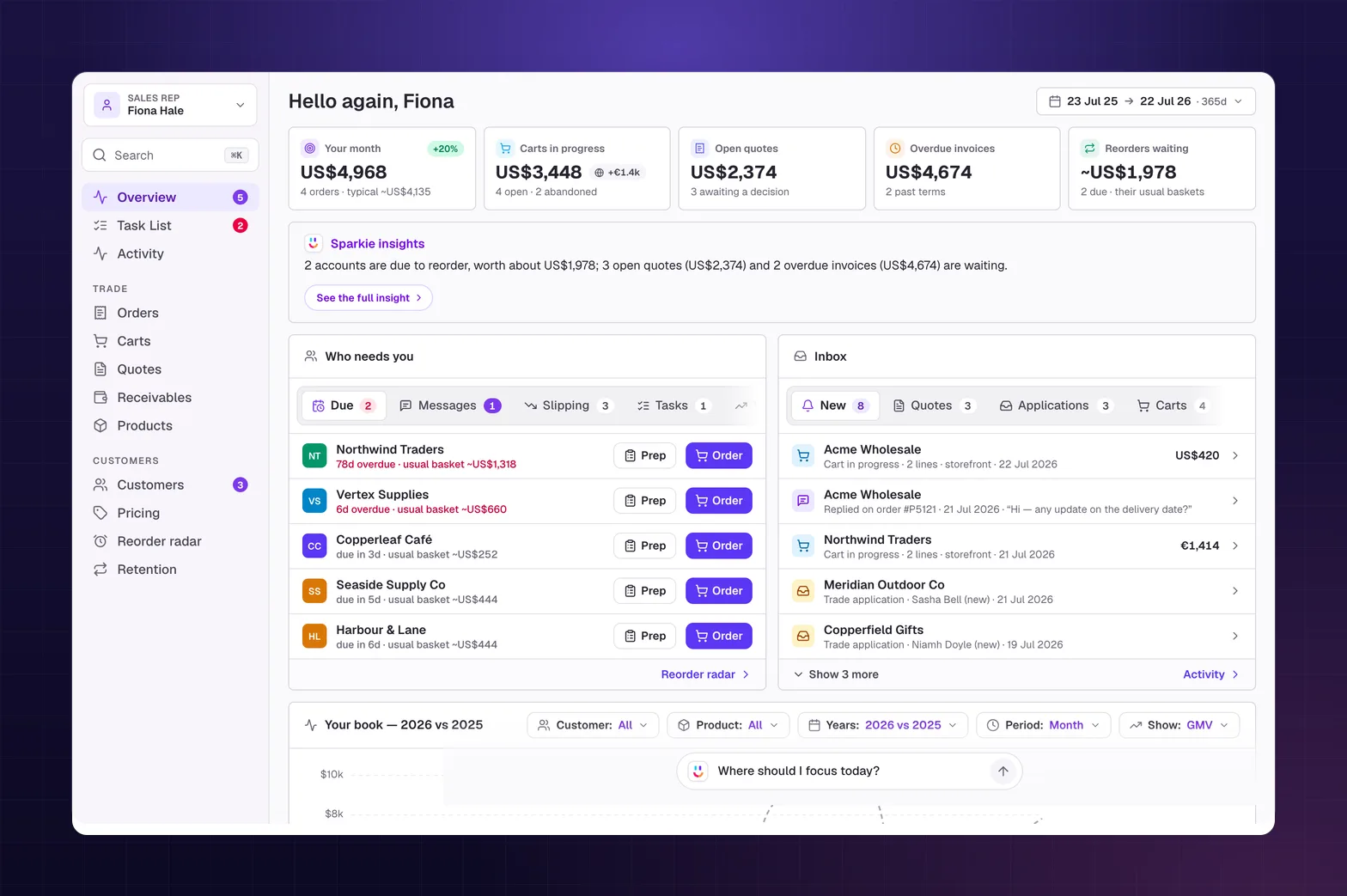
Pulse is a workspace for sales reps in the SparkLayer widget. It shows who to contact today and why, their orders, quotes, carts and unpaid invoices, and how each account is trading. It's in early access on every paid plan with a sales rep seat. See Pulse for what it does and to request access.
NewA new look for My Cart, My Account and sales rep ordering
The SparkLayer widget has a new design. My Cart, My Account and the sales rep screens now share one look, so they feel like one product, and they're easier to read at a glance.
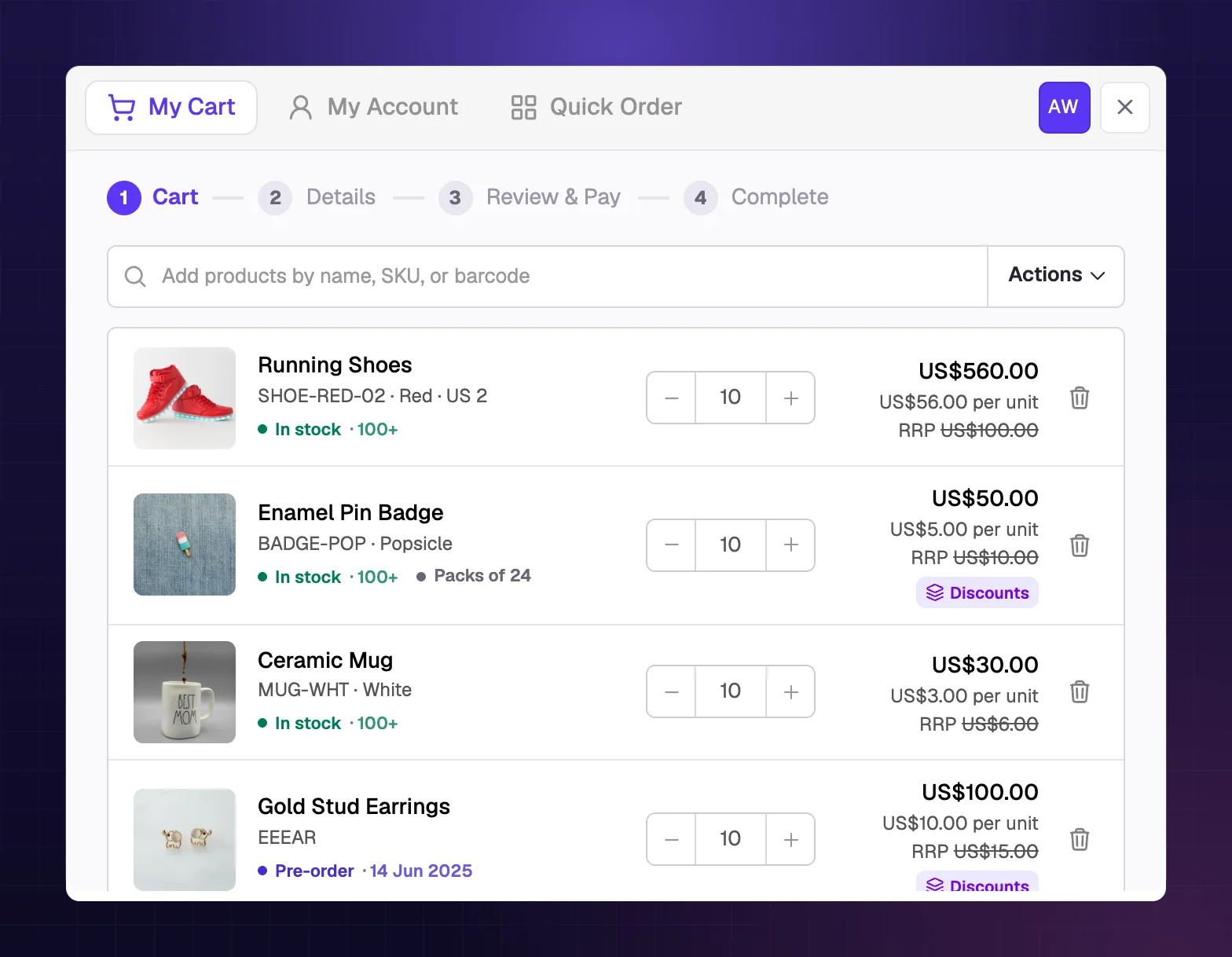
- My Cart puts the search for products by name, SKU or barcode at the top, with the Actions menu beside it. Each line shows its stock, pack size, price per unit and RRP, and checkout runs in 4 clear steps: Cart, Details, Review & Pay and Complete. See My Cart.
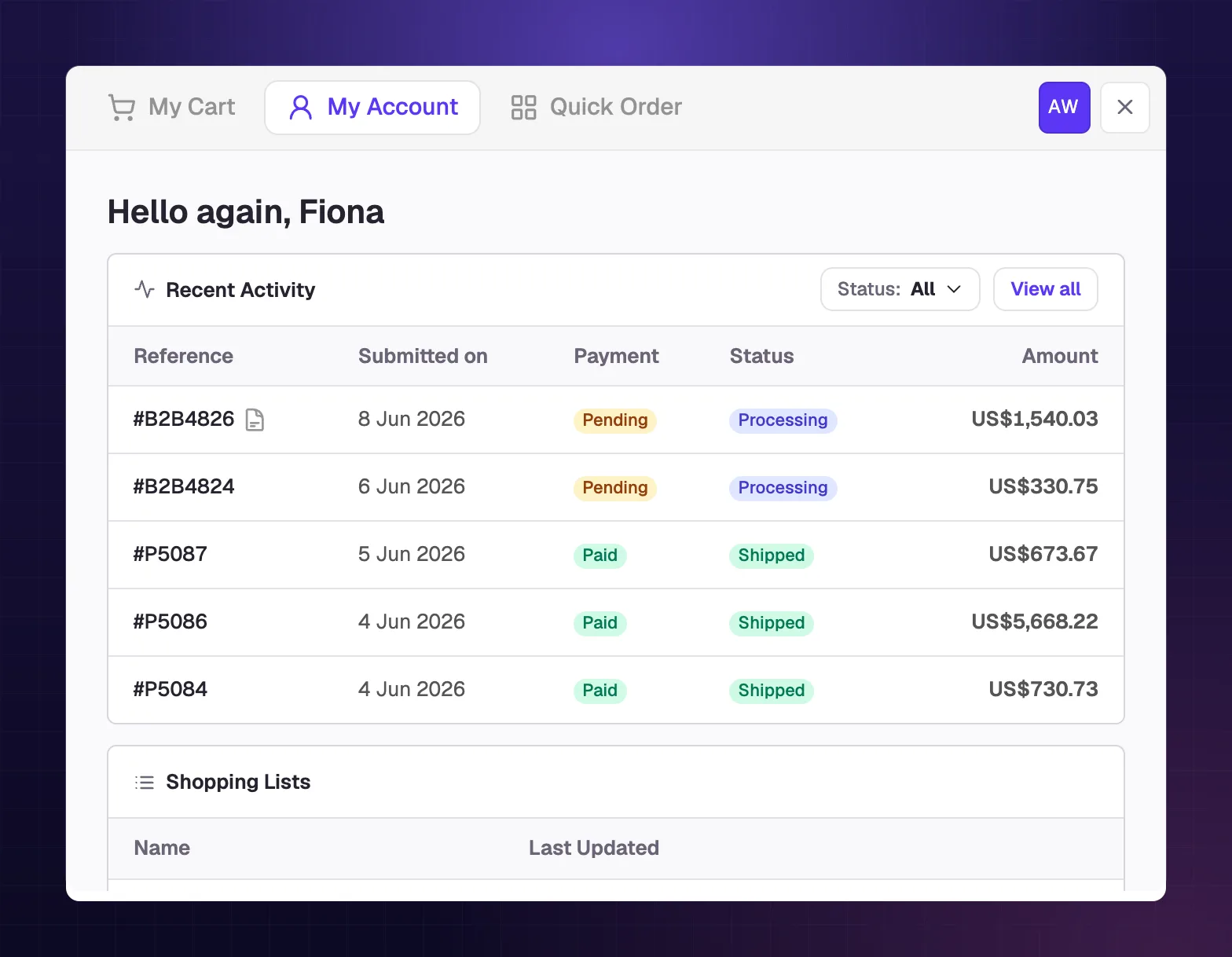
- My Account opens on the customer's recent orders, with their payment and order status, then their shopping lists, payment terms, unpaid balance and credit limit. See My Account.
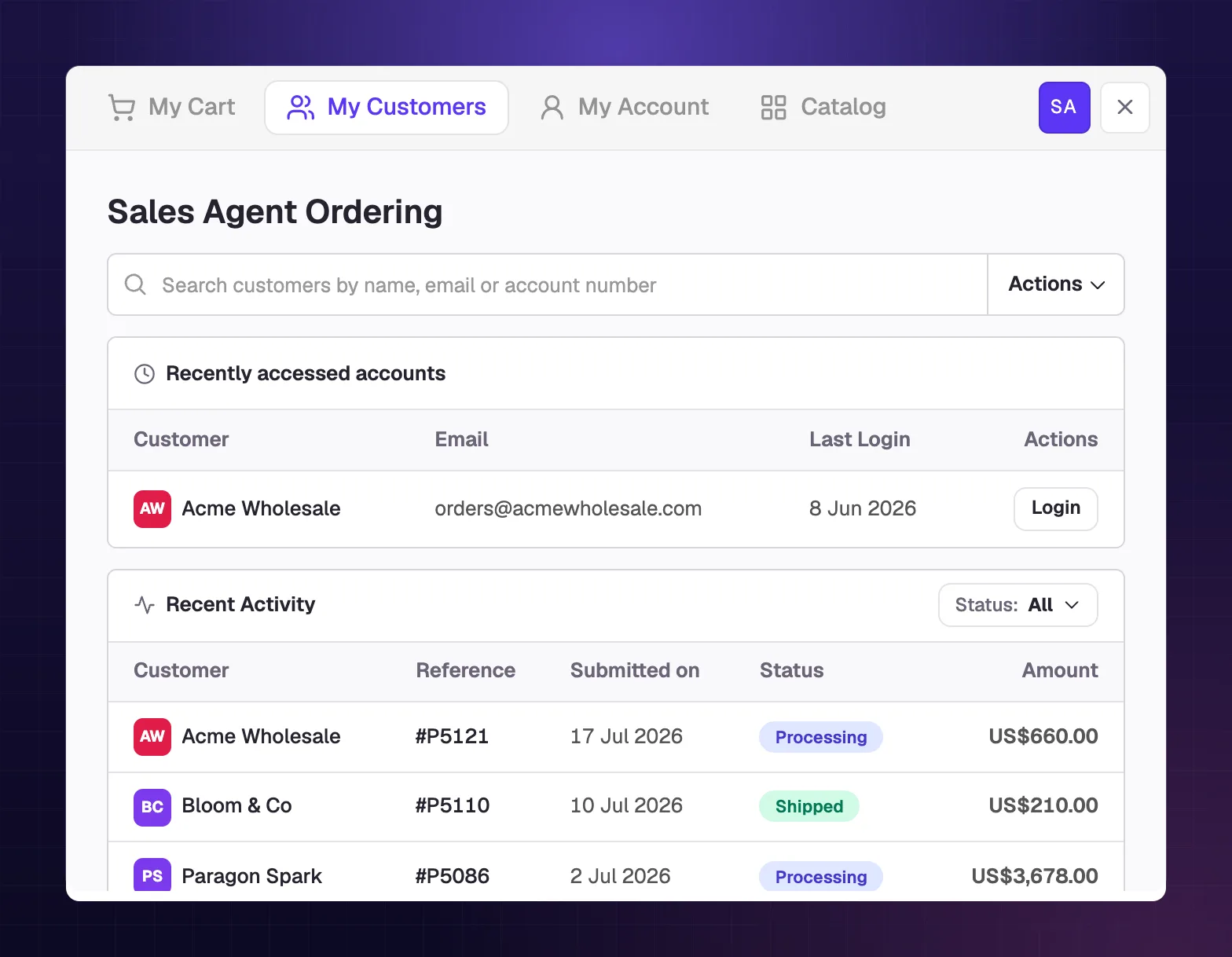
- Sales rep ordering shows the accounts you opened last and your customers' recent orders, with a search by name, email or account number. In the cart, the Ordering for button shows whose order you're building: click it to switch customer. See Order for a customer.
NewCatalog and Quick Order
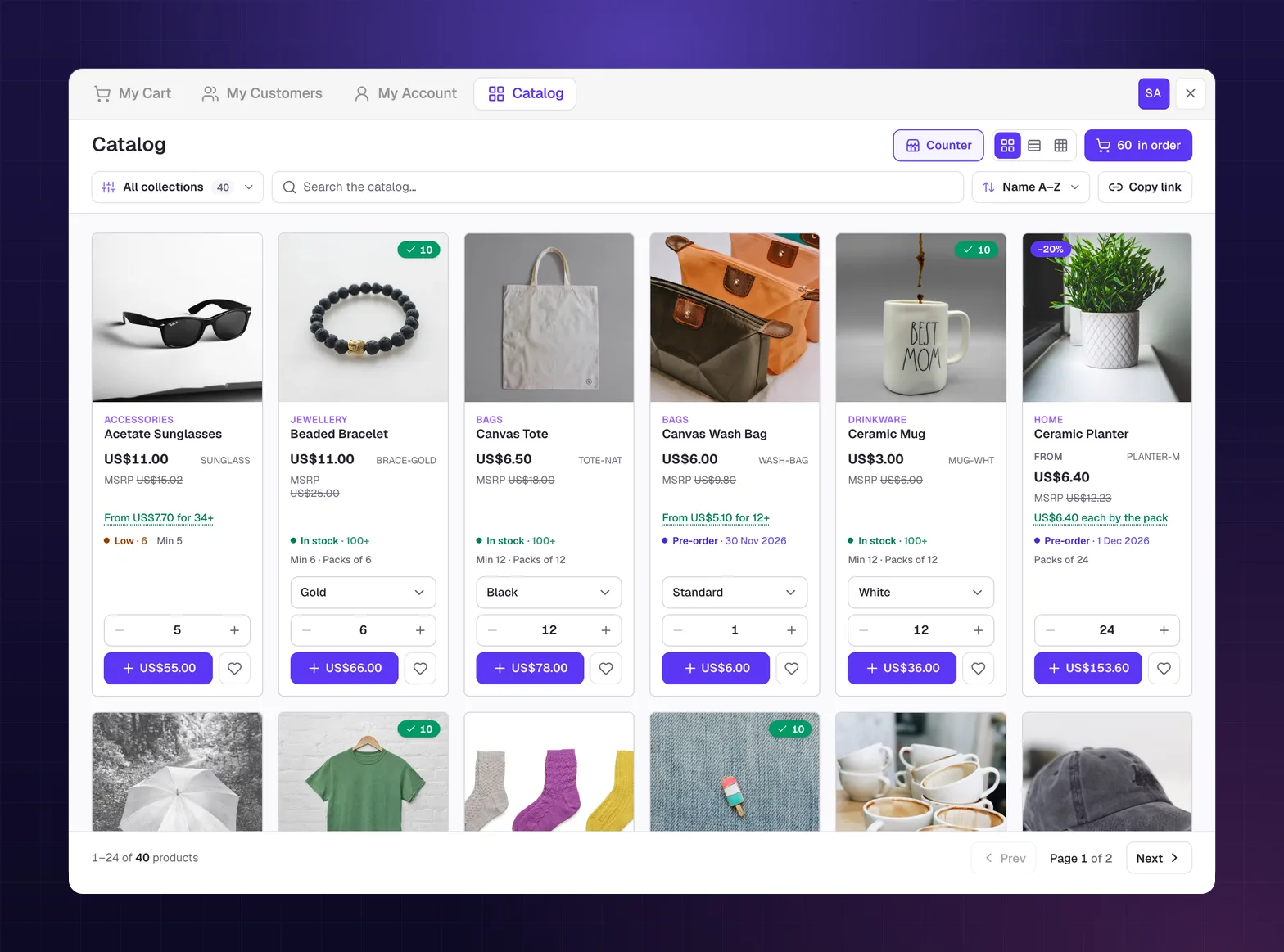
Browse your whole range in pictures and add products straight to the order. Sales reps see it as the Catalog tab, and your customers as the Quick Order tab. It has search, a collection filter, grid, list and matrix views, and quantities that follow your pack sizes and volume breaks. It's on the Starter plan and above, and needs SparkLayer 5. See Catalog and Quick Order.
NewCounter mode
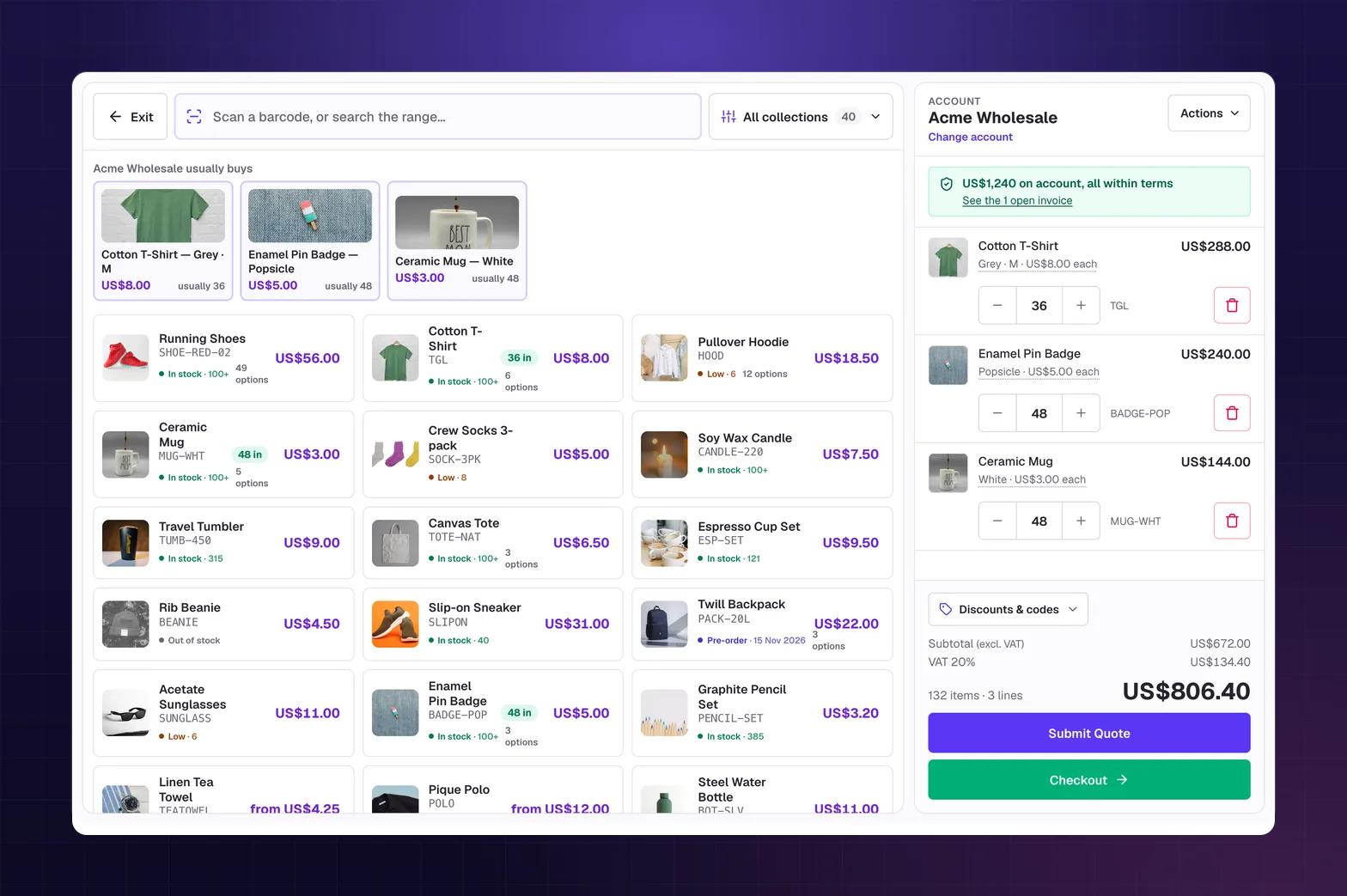
A full-screen till for sales reps serving customers face to face, at a trade counter, in a showroom or on a trade show stand. Pick who's buying, then scan or tap products, starting from what that account usually buys. You can see the account's credit position as you go, then check out on Net terms, send a card payment link or submit a quote. Open it with Counter on the Catalog tab. It's on the Starter plan and above, and needs SparkLayer 5. See Counter mode.
NewCompanies
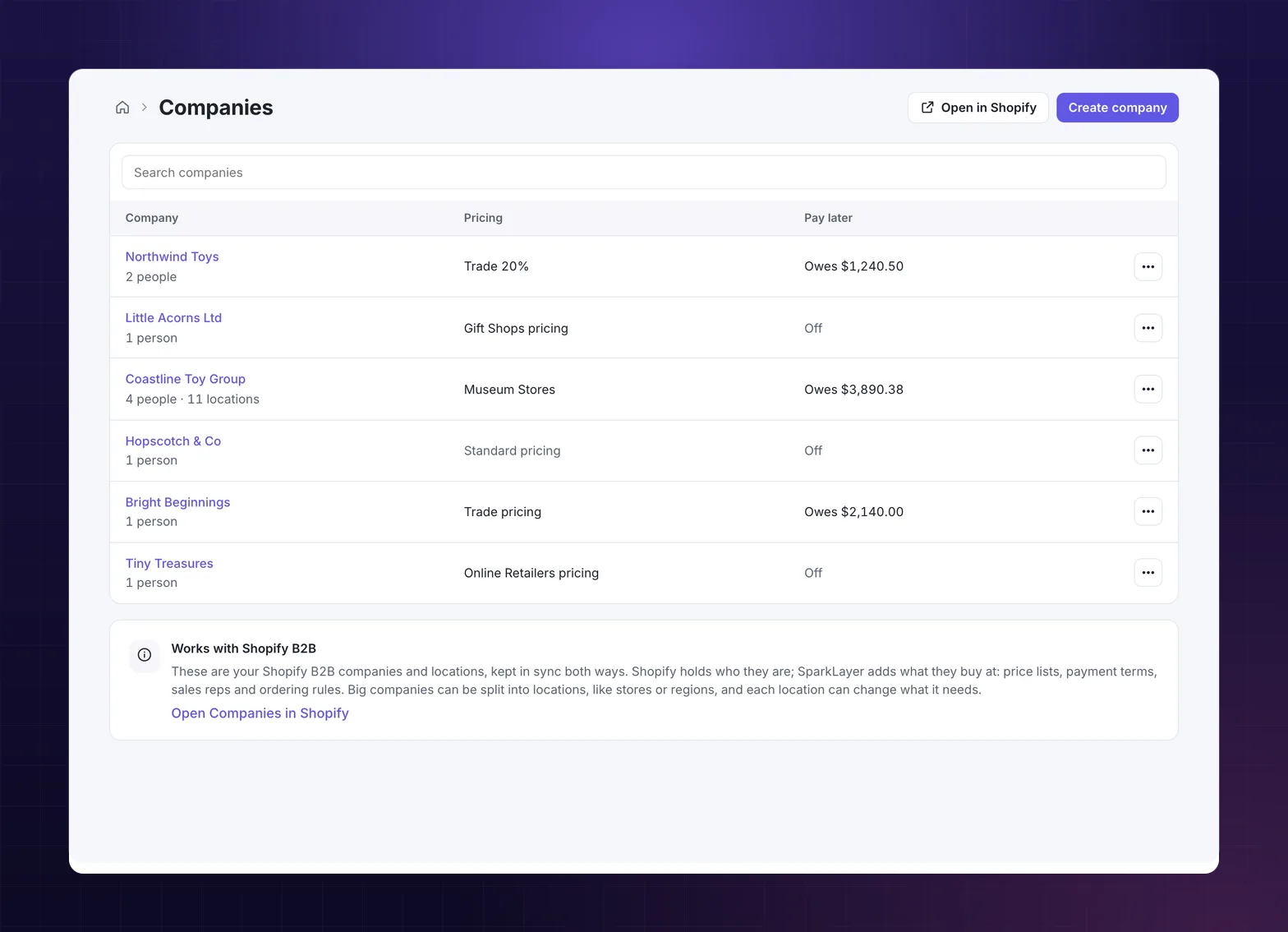
Companies and locations in SparkLayer: build them there, or sync them from Shopify B2B, where they're then managed. Set each company's customer group, price list, pay later, people and sales reps in one place. Split a big company into locations, such as stores or regions, each with its own settings where it needs them. Companies need SparkLayer 5. See Companies.
NewPayment method rules
Add a discount or surcharge to a payment method when an order meets your conditions, or hide the method altogether. Conditions can use the order's sub-total, its items, the customer's available credit or the shipping destination. For example, you could add a 2% surcharge to card payments under £500. You could also hide Pay on Account when a customer has less than £500 of credit left. Set the rules for each customer group. Payment method rules are for Shopify stores on the Growth plan and above, and need SparkLayer 5. See Payment method rules.
NewAsk Sparkie
An AI assistant in the SparkLayer app. Ask about your price lists, customer groups and store setup in your own words, or describe a change, such as "Create a price list 30% off retail for Gift Shops". It prepares the change as a card for you to check, and nothing changes until you approve it. Open it at Ask SparkLayer, or type in the box at the top of Home (opens in your SparkLayer Dashboard in a new tab). It's in early access, on every plan. See Ask Sparkie for what it does and to request access.
NewSparkLayer MCP
Connect Claude, ChatGPT, Cursor or another AI app to your SparkLayer store. A connected app can read your store data, such as price lists, discounts, B2B customers and orders, and make the changes you confirm in its own chat. You choose the stores it works on, and whether it uses live or test data. It's in early access. See SparkLayer MCP to request access.
NewShopify Sidekick
Ask Shopify Sidekick, Shopify's AI assistant, about your SparkLayer price lists and customer groups from any page in Shopify admin. There's nothing to set up: it's included with the SparkLayer Wholesale app. Sidekick only answers questions; to make a change, use Ask Sparkie. See Shopify Sidekick.
Improvements
-
Upgrade to SparkLayer 5 yourself
Switch your store to SparkLayer 5 from Storefront,Widgets,SparkLayer version (opens in your SparkLayer Dashboard in a new tab), in the SparkLayer Dashboard or the Shopify app, without contacting support. See Upgrade to SparkLayer 5.
-
A fresh new look for the SparkLayer Dashboard
The SparkLayer Dashboard and the Shopify app have a fresh new design. Everything is cleaner and easier to find: a simpler menu groups every screen by area, and Home shows how your wholesale is doing and what to do next. Some screens have moved or been renamed. See Where things moved, or take the tour below.
Home
Walk through a working copy of Home, step by step. Nothing you do here changes your store.
NewDark mode is now universally enabled
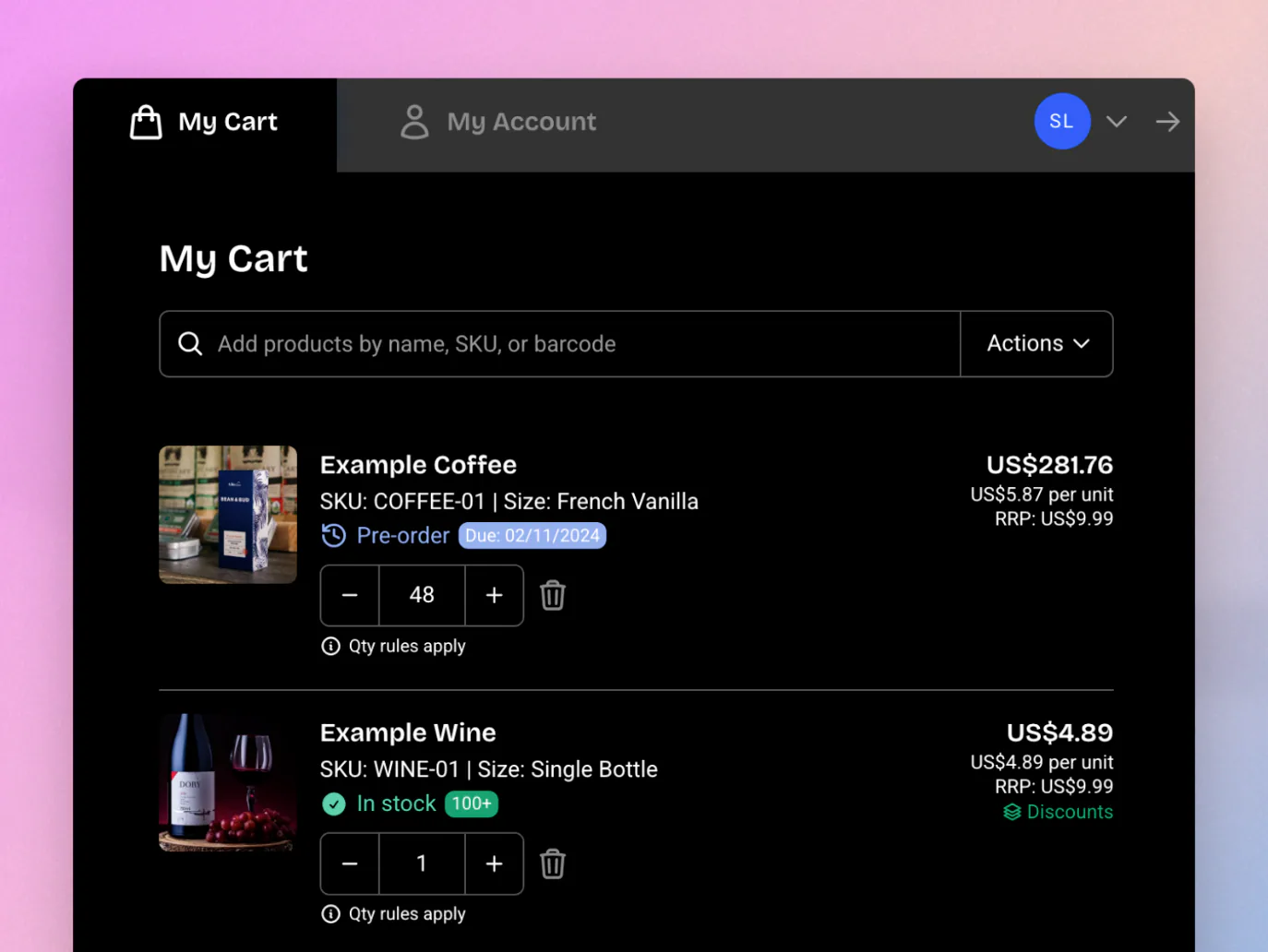
In our latest version of SparkLayer, you can now enable dark mode on all the SparkLayer interfaces. Previously, this was limited to just the product pages - with our latest update dark mode now works in the My Cart Interface and the My Account Interface to give a much more cohesive experience. To enable dark mode, see Customising the design.
NewAdd to Favourites
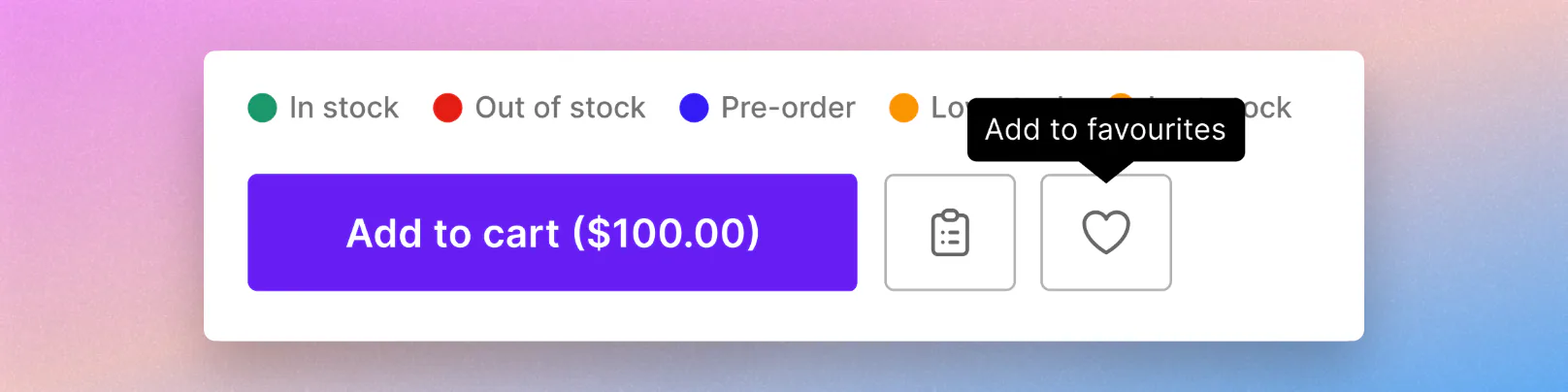
Your B2B customers can now save products as they browse by clicking the heart icon on any product or collection page!
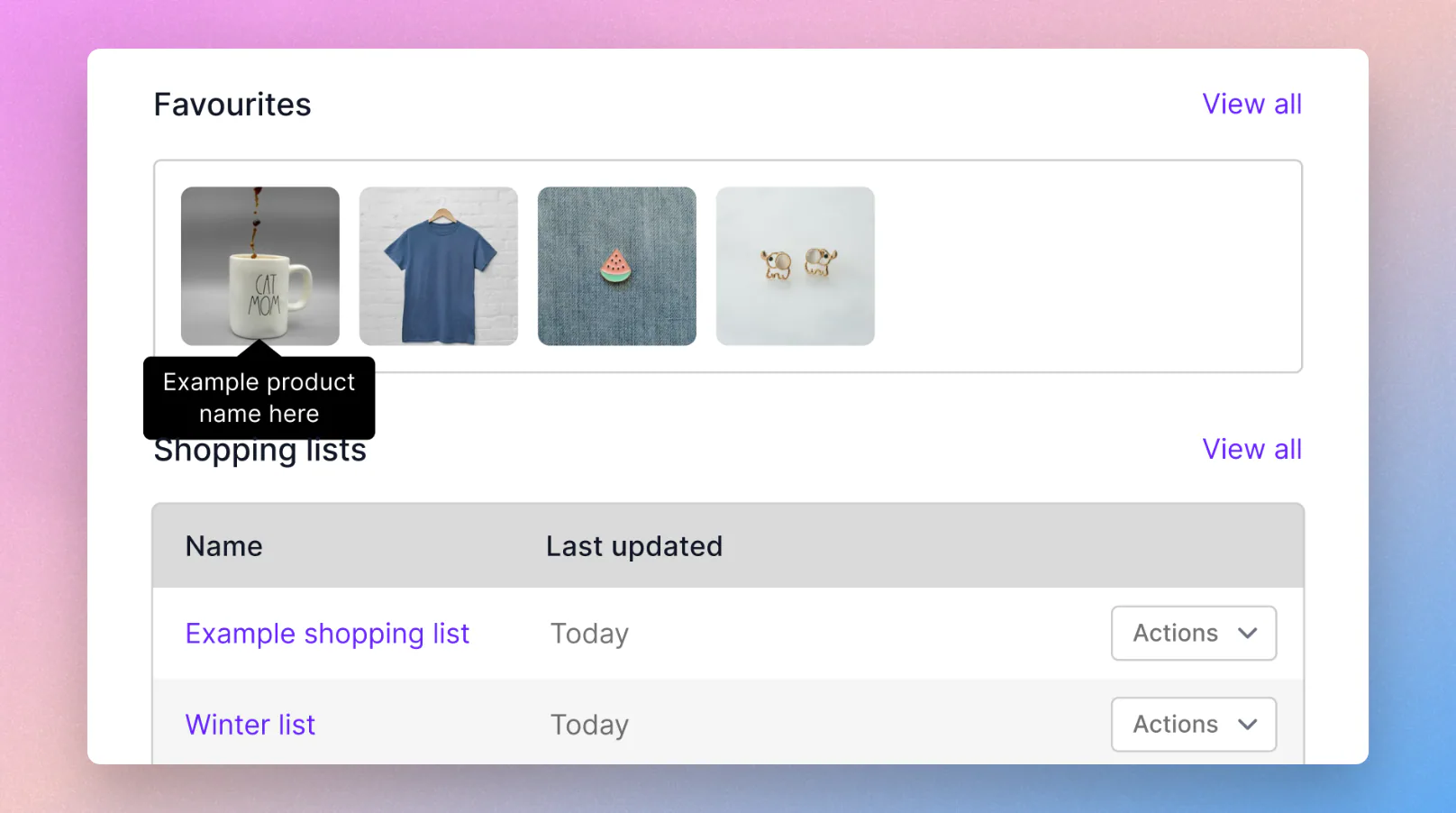
Saved products live in a new Favourites section in My Account, right alongside shopping lists, where customers can return to them any time and add them straight to the cart. It's a lightweight way to mark products for later - no quantities or variants to manage - and it's personal to each customer.
Learn more in Favourites.
NewTax-inclusive price display
You can now show your B2B prices with tax included, clearly labelled "inc. tax", so buyers who think in gross terms see exactly what they expect. It's built for markets where gross pricing is the norm - common in Australia and across trade sectors selling to smaller businesses - and gives you far more flexibility in how you present pricing across different markets.
Importantly, this changes presentation only. Your prices are still stored, uploaded, and transacted net, and the tax your buyer actually pays is still calculated by your store's checkout at the point of purchase. Only the figure shown on your storefront changes.
- Show the price your buyers expect - display gross prices without changing how you upload or transact your pricing.
- Control it per price list - turn it on for the price lists that need it and leave the rest showing net, so you can serve different markets from one store.
- Set your own rate per product - supply a display tax rate per SKU, so reduced-rate and zero-rated products show correctly alongside standard-rate ones.
- Clearly labelled throughout - gross prices and the "inc. tax" label appear across product pages, cart, checkout, and order history, so there's no ambiguity about what a buyer is seeing.
To turn on tax-inclusive display, see Show tax-inclusive prices. Learn more about displaying RRP pricing
Improvements
-
My Account discount display
When an order is placed with discounts applied, you can now see the discount total breakdown when viewing the order in the My Account.
-
A refreshed look across the dashboard
We've given several dashboard pages a visual update as part of standardising the experience - Price Editor, Product Sync, Discounts (including create and edit), and the Configurations pages all now share a cleaner, more consistent design.
NewConfigure SparkLayer from the Dashboard - no code required
Settings that previously had to be added to your theme's core script using JavaScript and JSON can now be managed visually from the new Options page in your SparkLayer Dashboard.
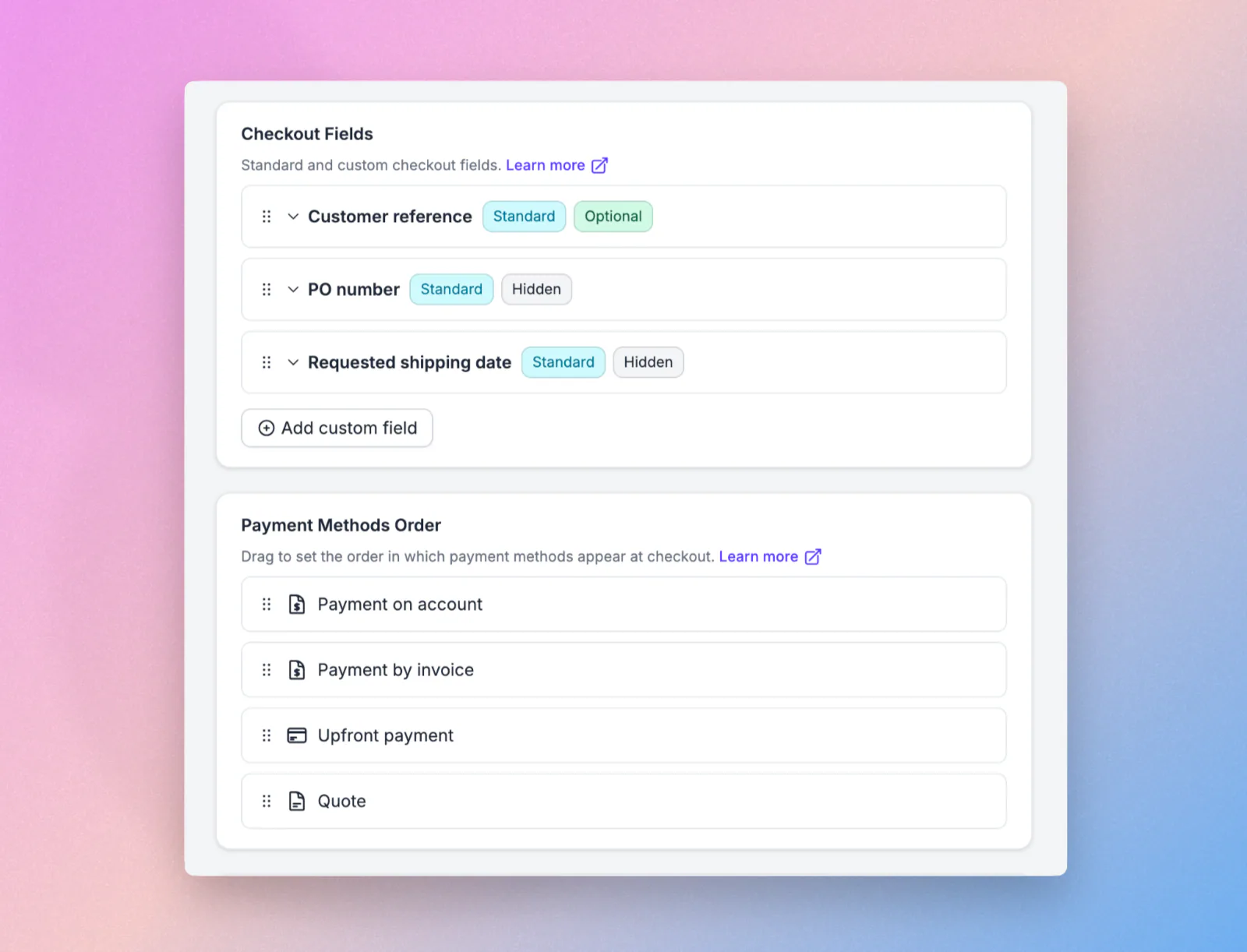
Adjust general settings, translations, checkout fields, payment method order, My Account sections, custom slots, and analytics, then save as a draft and publish when you're ready. It works alongside your existing core script, so nothing you've already set up changes. Learn more in Storefront options
NewStandard checkout fields
Customer Reference, PO Number, and Requested Shipping Date are now available as standard checkout fields.
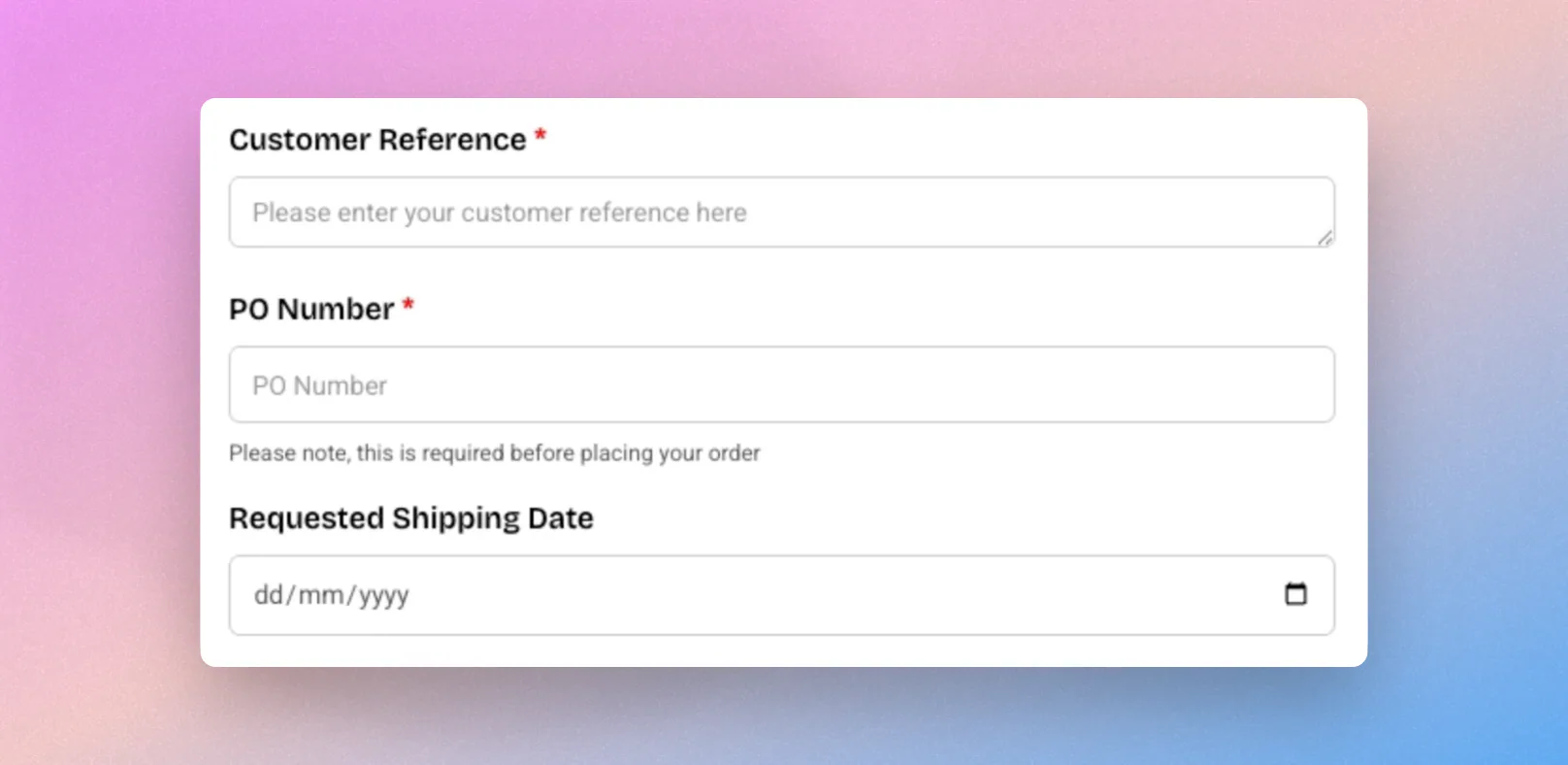
Because each one uses a known field ID, it maps to a structured place in your orders - the native Shopify PO Number field, a dedicated shipping date field, and the order notes - so they integrate more cleanly with Shopify, appear in your theme and template editor, and can be searched and filtered. Learn more about cart and checkout options
Improvements
-
Wix dashboard and onboarding experience
We've redesigned our Wix dashboard to make it even easier for merchants to get setup! From right within Wix, you can now view available features, sync health & analytics, manage customer groups, manage price lists, and a new 'Quick Setup' page to get merchants live super fast
-
Upload Excel files to AI file upload
You can now upload Excel (.xlsx) files directly to AI file upload, alongside the existing CSV and PDF support. Customers and sales reps can turn a spreadsheet of products straight into an order, without converting it first. Learn more in Intelligent Cart (AI)
-
More accurate quantity detection in uploaded files
AI file upload is now better at identifying the correct quantities in the files customers upload, making order creation from documents quicker and more reliable.
-
Duplicate forms in one click
You can now duplicate any form from within SparkLayer Forms (opens in a new tab)
-
Hide the Intelligent Cart features
If you'd prefer not to use the Intelligent Cart (AI) features within the SparkLayer Cart, you can now hide them at Settings,Configurations (opens in your SparkLayer Dashboard in a new tab). See Hide Intelligent Cart.
NewShopping Lists just got a major upgrade
Managing shopping lists is now faster and far more flexible! Products can be saved to a list straight from any product page, and lists can be fully managed from within the My Account area - including previewing, adding, and editing their contents. Your B2B customers and sales reps can also export any list as a CSV, making it easier to share and reorder across teams. Learn more about shopping lists
NewOrders API - build and manage orders
The Orders API is in beta
To be invited, email support@sparklayer.io.
We've extended our Core API with a new Orders API, giving developers a programmatic way to build and manage orders. The new endpoints let API users create and manage shopping carts and turn them into SparkLayer orders in code - opening up use cases such as creating orders through external integrations, for example drop shipping. Any store with API access has this automatically. See the API documentation and the usage guide to get started.
NewFetch customer-specific pricing via the API
As part of the same release, a new endpoint lets API users fetch customer-specific pricing for products, so integrations can pull the exact prices a given customer sees. Learn more in the API documentation.
Improvements
-
My Account / My Cart - Expand button moved to the user menu
The "Expand" button now lives in the user dropdown menu, freeing up space for more important actions within each page.
-
Clearer impersonation view for sales reps
When viewing as a sales rep, you can now see exactly which customer you're impersonating on every page, making it easier to keep track when ordering on a customer's behalf.
NewExport Purchase History to CSV
You can now export orders (including quotes and any other purchase types) directly from the Activity view as a CSV file, ready for Excel or Google Sheets. Choose between an order-level summary or a full breakdown with every line item, and any filters you've applied carry through to the export. Available from the customer or sales rep view. Learn more in My Account. (Requires Spark-JS Version 4.4 and above)
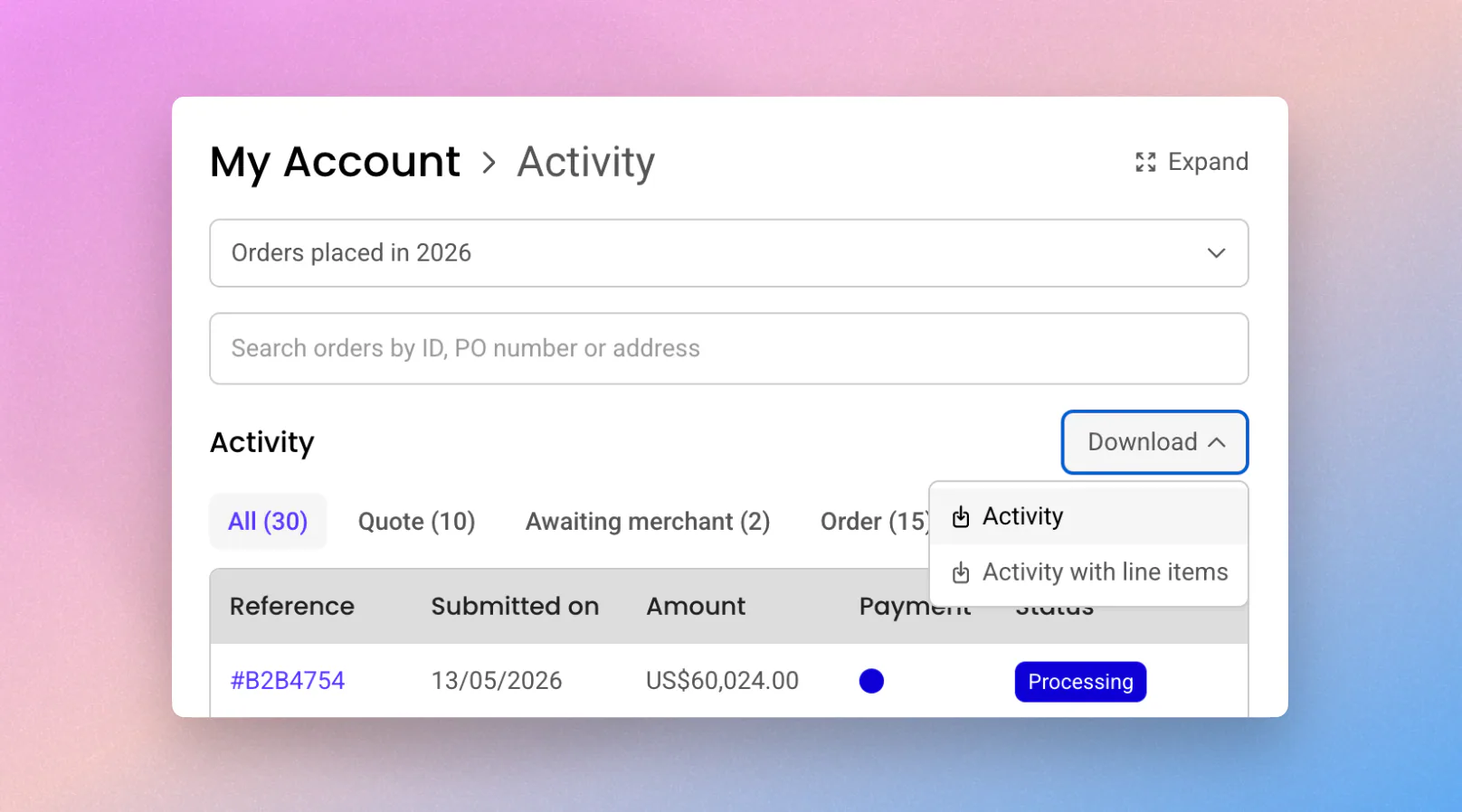
NewReply Directly from Your Inbox
No more logging in just to reply to a message. You and your customers can now respond to order communications straight from your email inbox, with replies automatically captured in SparkLayer's Timeline. It works across all order types, making it effortless to keep conversations going - especially on mobile, when you're on the go. Learn more in Timeline & communications. (Requires Version 4.3 and above)
Improvements
Customer & Order Data in Forms
You can now pull customer and order data (including quotes and any other purchase types) directly into your SparkLayer forms. Great for cases like returns forms, where shoppers can select from their previous orders and items without re-entering details, and sales reps can request customer data to be updated. Learn more in Account credit request form.
Address improvements
Entering addresses just got easier - especially for international buyers. Address forms now adapt their layout and name ordering to the selected country, and offer address search and auto-fill. The result is faster, more accurate data entry wherever your customers are based. Learn more in My Account. (Requires Version 4.5 and above)
Improvements to Sales Rep Activity Filtering
Sales reps get the same export options across all their customers, and, similar to the customer view, they can now filter by the new purchase type and quote status filters. Making it easy to reconcile orders, forecast inventory, or plan pre-orders. (Requires Version 4.4 and above)
Internal Customer API upgrades: We've released V2 of our Customer API, now available to all Shopify stores (and in June we'll move the other platforms over). For customers who are already using the V1 Customers API, you can continue to use the V1 API for the next 6 months till the 1st of December 2026. The upgrade path is straightforward, and we’ll provide more information about the changes soon.
NewA better way to onboard customers.
SparkLayer Forms is a flexible way to capture, review, and manage B2B information at every stage of the customer lifecycle — from first enquiry through to ongoing account management or even a contact form for your site.
It includes a workflow editor (on the Growth plan and above) that can tag customers automatically, make API calls to push new customers to your ERP, or even approve customers automatically when their tax ID is validated. See Form workflow automations. Learn more in Forms.
NewCatalogs
B2B Catalogs (opens in a new tab) is a free SparkLayer app (for Shopify) that gives you control over which products are visible to different types of customers on your Shopify store. Whether you want to hide specific products from B2C customers, restrict certain items to B2B customers only, or show different product ranges to different customer groups - B2B Catalogs makes it easy to manage from your Shopify admin.
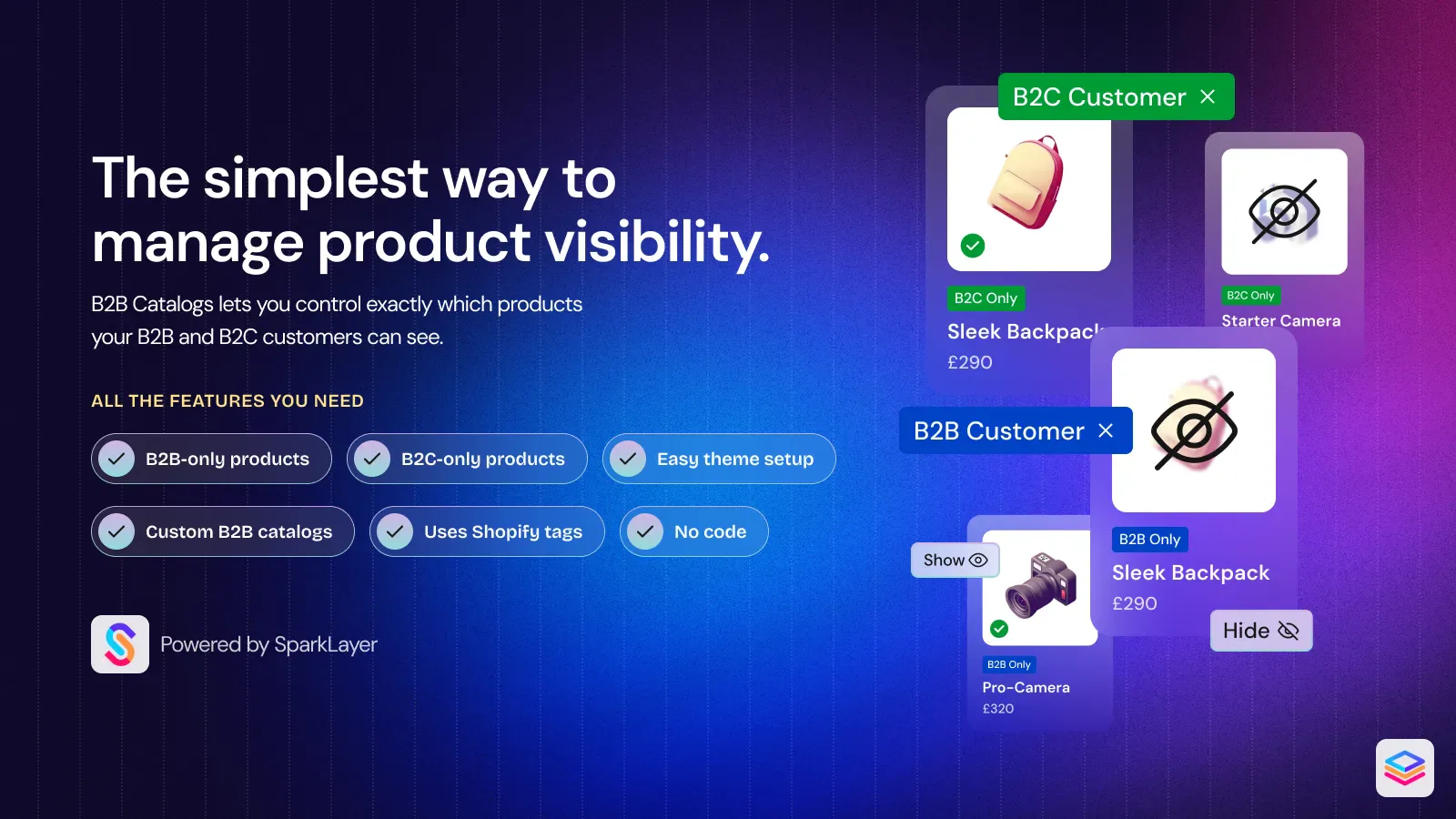
NewSales reps' roles.
Sales rep roles let you control what each sales rep can see and do in SparkLayer - so the right people have the right level of access. Instead of managing permissions individually, you can create reusable roles and assign them across your team. Available for anyone with sales reps. Learn more in Sales rep ordering.
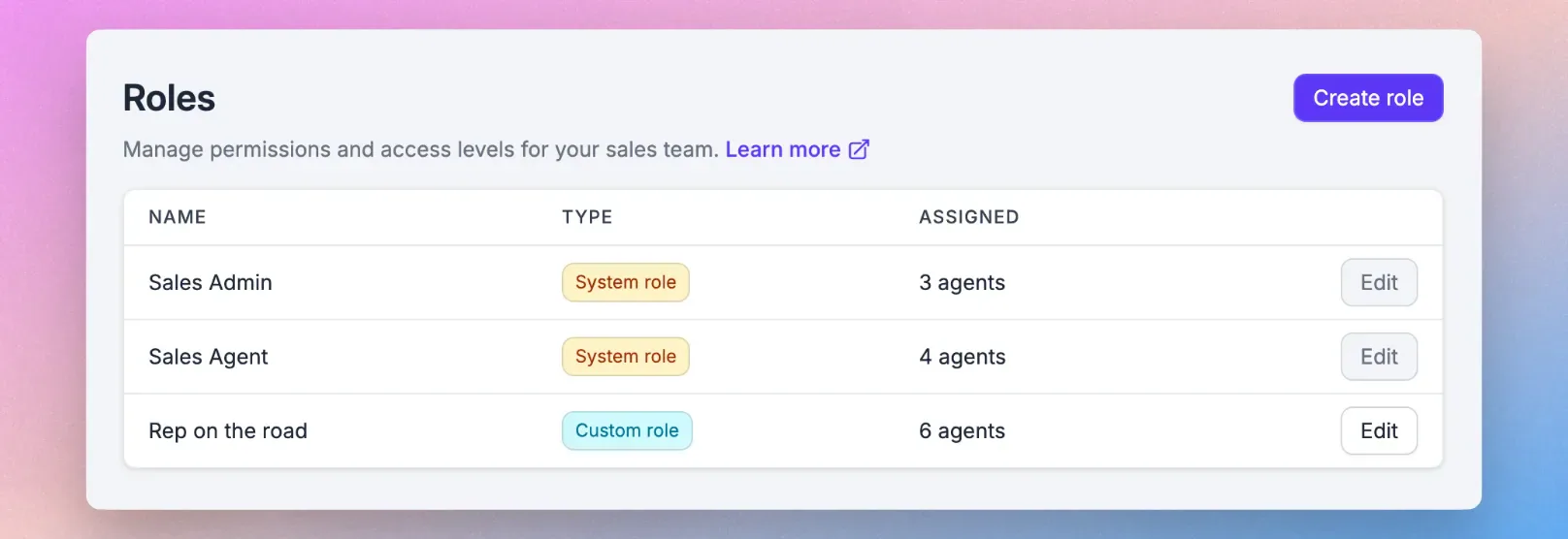
NewCustom email domain
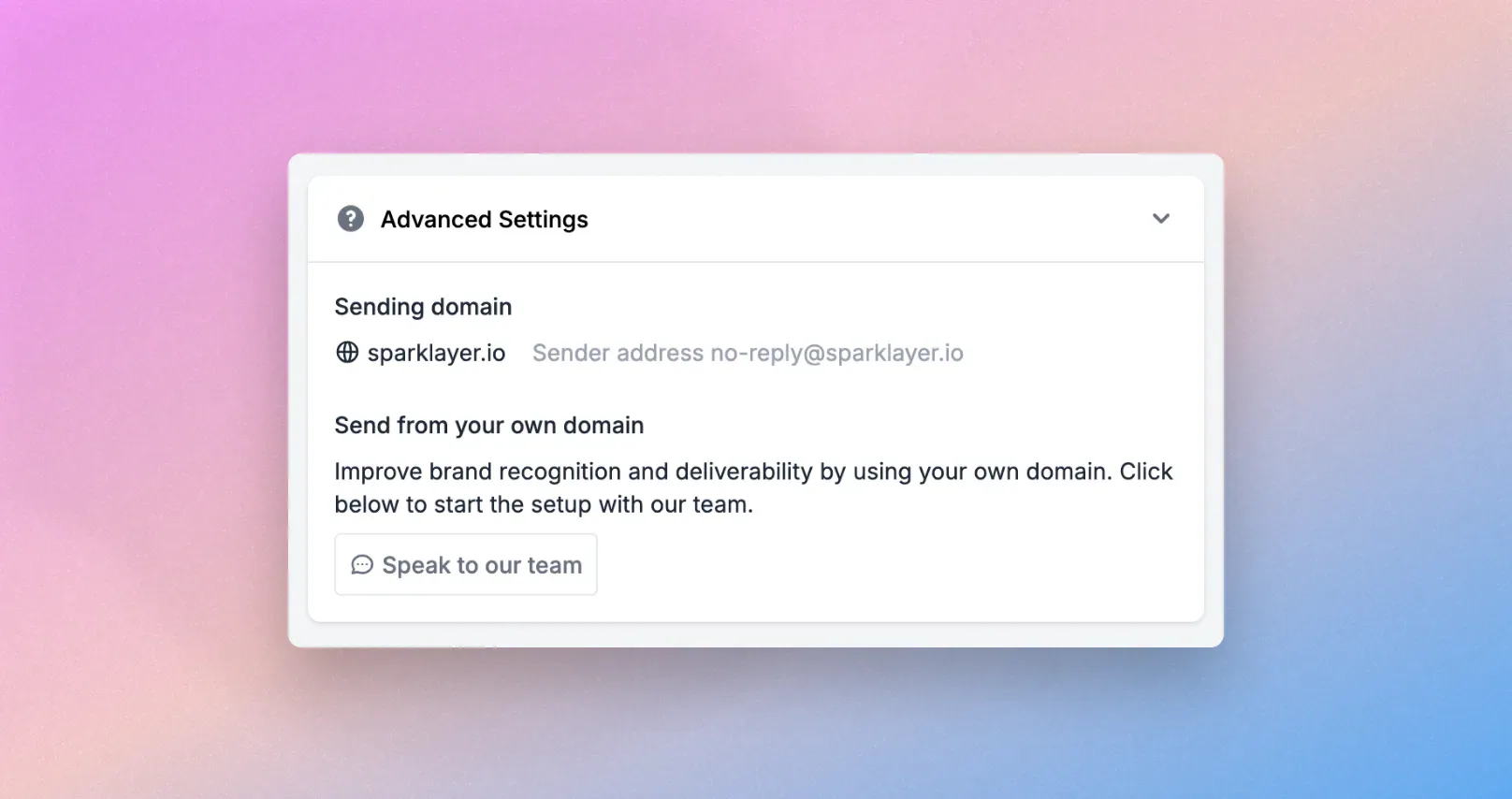
Improve brand recognition and deliverability with support for custom "from" email addresses (e.g. store@mail.yourstore.com), helping ensure notifications match your brand. Available on Pro and Enterprise plans. Learn more in Timeline & communications.
Improvements
- Dashboard Customers and Sales Rep page - New and improved visibility for customers, customers syncing and sales reps.
- Disable specific email templates - Through a minor template change, it is possible to disable a email template and this could be actioned based on logic. Learn more in Quoting Engine.
- Package level invoicing for Xero/Quickbooks - Invoices are now shown at package level rather than multiple invoices shown at the order level.
- Company Users is now available for all plans.
Improvements
- Shopify Company support - SparkLayer will automatically place orders under the correct Shopify company when a customer is attached to one. Learn more in our full guide, Shopify Companies
- Multilingual Shopify Shipping support - Support for multilingual shipping names when using Shopify shipping.
NewPayment Visibility within SparkLayer
Cut down on support admin by letting your customers check their financial standing themselves.
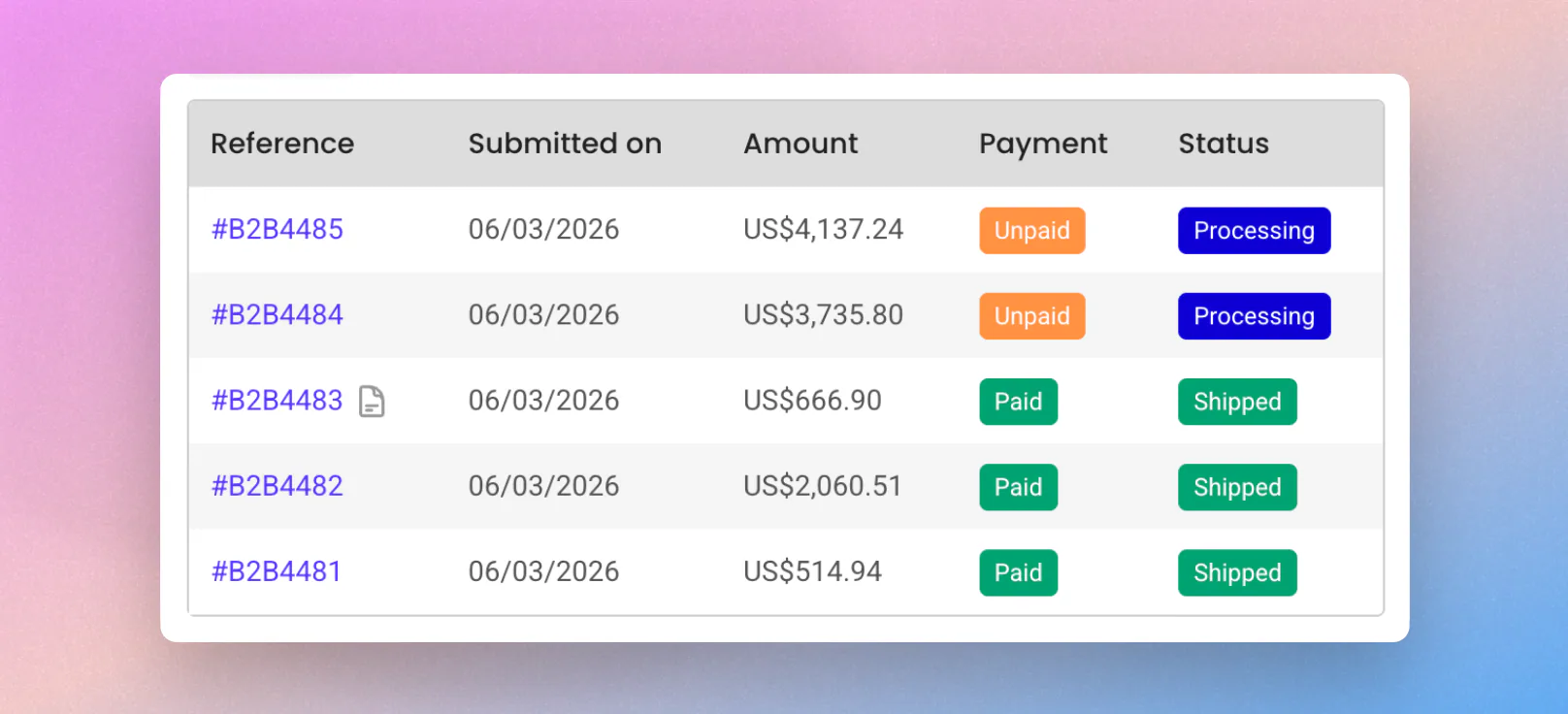
This new feature provides real-time account balances, payment statuses, and transaction histories directly in the My Account area. To read more see Payment Methods.
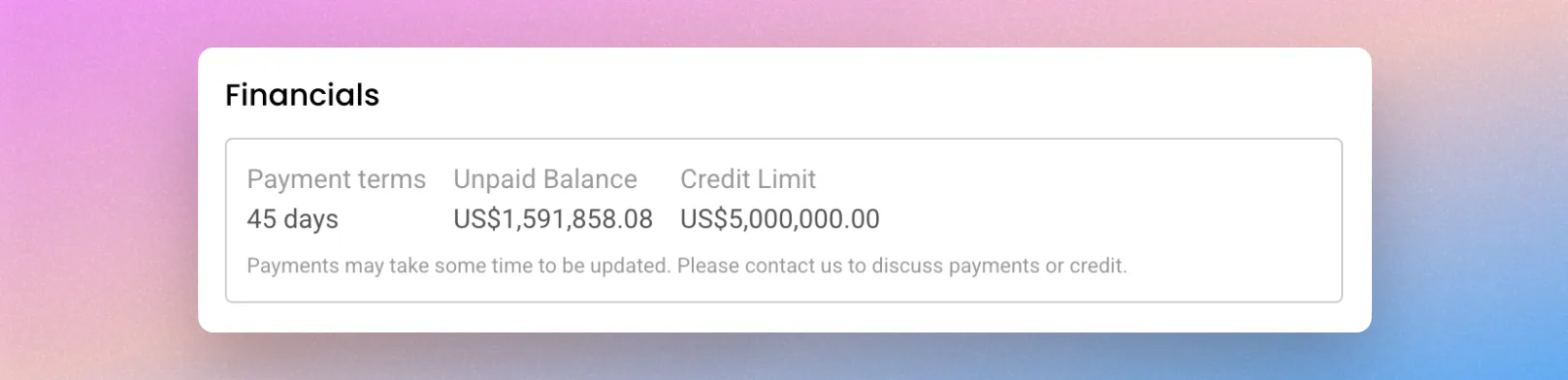
The key elements:
- Payment status is now visible within the order listing and the order details tab (Paid, Unpaid, Partially Paid)
- Transactions are now visible within the timeline section of the order.
- The balance shown in the Account section has now been updated based on payments.
This feature can be enabled easily via the SparkLayer Dashboard (opens in a new tab). Compatible with Shopify, Xero, and QuickBooks Online.
Improvements
- Speed, Polish, and Performance Upgrades (Version 4+)
- Speed Boost: Enjoy snappier loading for products, carts, and accounts thanks to smarter caching.
- Visual Polish: A cleaner, more refined look across the interface with improved layouts, spacing, and typography.
- Better Shopping Flows: More reliable cart updates, smoother reordering, and a simplified quantity selector.
- Accessibility & Fixes: Upgraded screen reader support, better right-to-left (RTL) language layouts, and a solid round of bug squashing.
- Dashboard Price Lists and Customer Groups page - New and updated design for the price lists and customer groups page, we'll be rolling out more pages in this design over the coming months.
- Improved Product Selection Dropdowns - Invalid selections on Product Details Page dropdowns are now hidden rather than disabled, creating a cleaner interface for your customers. (Version 3.17.0+)
Improvements
-
Discounts - Exclude Specific Customers
Discounts can now exclude specific customers using email addresses or accounting IDs, giving more control over who can use each promotion. Learn more about discounts
-
Quotes - New Email Notifications
We’ve added three new quote emails that the customer will receive, to make it clearer when a quote has been created or updated:
- First response from a Sales Rep to a quote request
- Subsequent quote updates made by a Sales Rep
- New quote created by a Sales Rep and sent to a customer
NewXero and QuickBooks Online integrations announced
We announced SparkLayer's Xero and QuickBooks Online integrations. They're now live, on the Pro plan and above: see Xero and QuickBooks Online.
NewTimeline & Communications
Timeline & Communications has expanded beyond Quotes and is now available across all supported order types. Messages, internal notes and order updates are brought together in one clear, chronological timeline, giving your team and customers a unified place to track communication and activity as orders progress.
The result is a consistent, streamlined experience - whether you’re managing standard B2B orders, quotes, or draft orders created by Sales Reps. Learn more in Timeline & communications.
NewDashboard Design Updates
We’ve refreshed the SparkLayer Dashboard with a streamlined sidebar that makes navigation simpler, faster, and more organised.
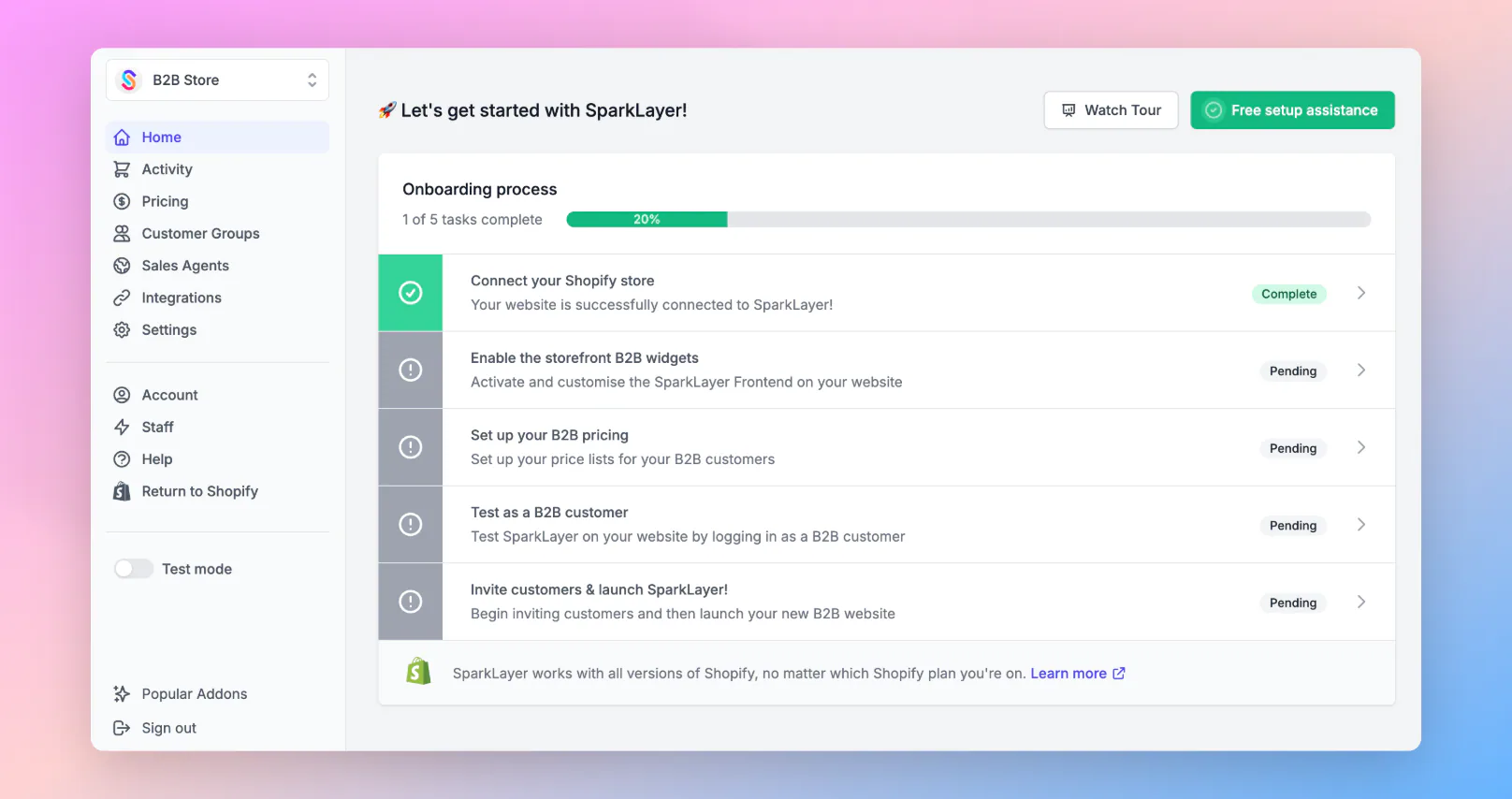
- Customer and Product Sync now sit under Integrations, alongside platform connection, Partner Integrations, and Widgets.
- Discounts is now grouped with Pricing, alongside price lists and Price Editor, reducing clutter and keeping pricing tools together.
The result is a cleaner layout and clearer structure that lets you focus on what matters most - your store’s performance.
Improvements
-
Stock Display - Option to hide pre-order status
A new configuration within customer groups allows you to hide the “pre-order” stock status from customers.
NewQuote Status Improvements
You can now filter quotes by individual status, giving you greater granularity and control when managing quotes. Previously shown in a single view, quotes can now be broken down by stage for easier tracking and follow-up.
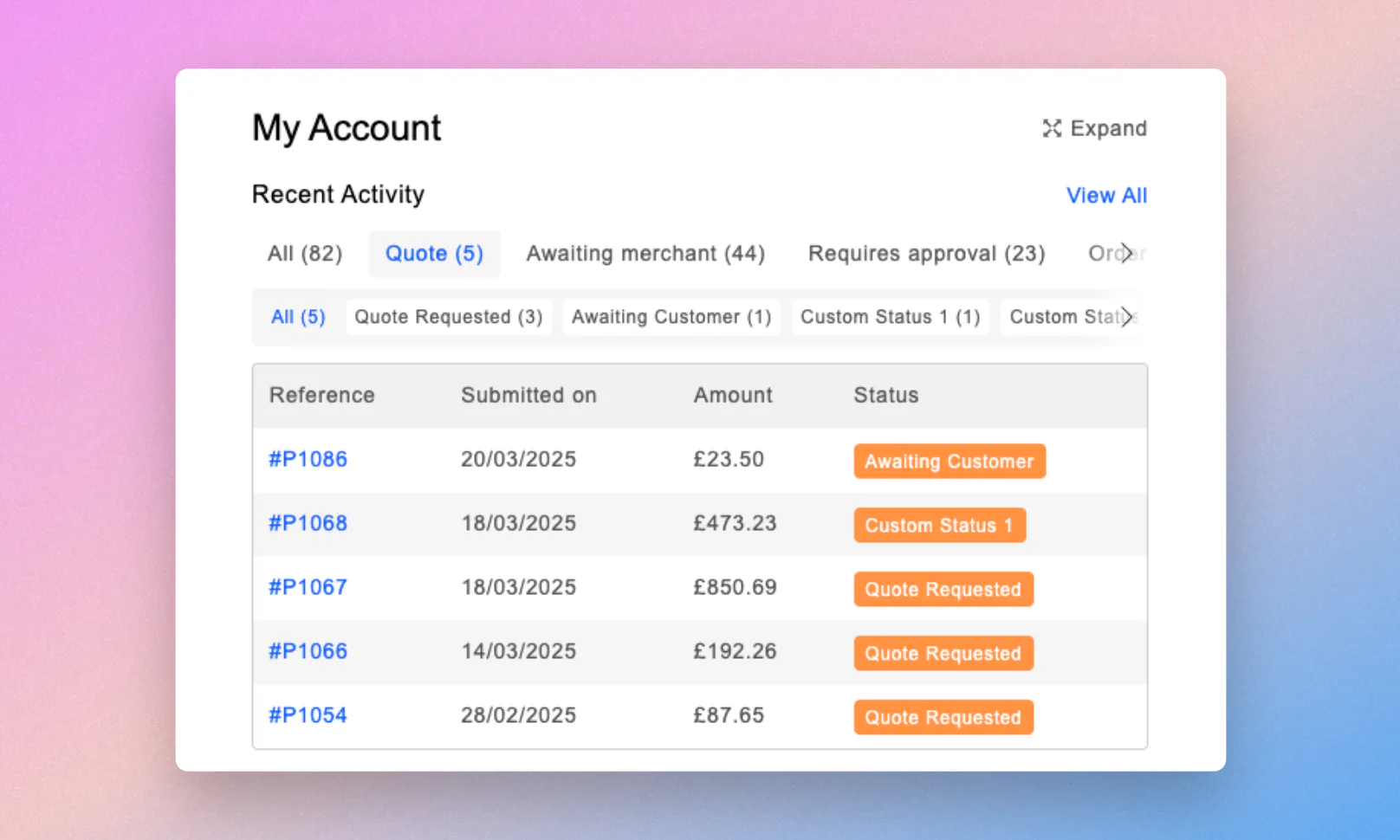
Custom statuses are automatically included, and a new chevron indicator shows when more filters are available to scroll through. Statuses have also been reordered to reflect logical quote progression for a smoother workflow.
NewShipping Restrictions by State/Province
You can now limit shipping methods to specific states or provinces within the US, Australia and Canada, allowing more precise regional control. This makes it easier to tailor delivery options, manage exclusions, and align shipping availability with your operational areas.
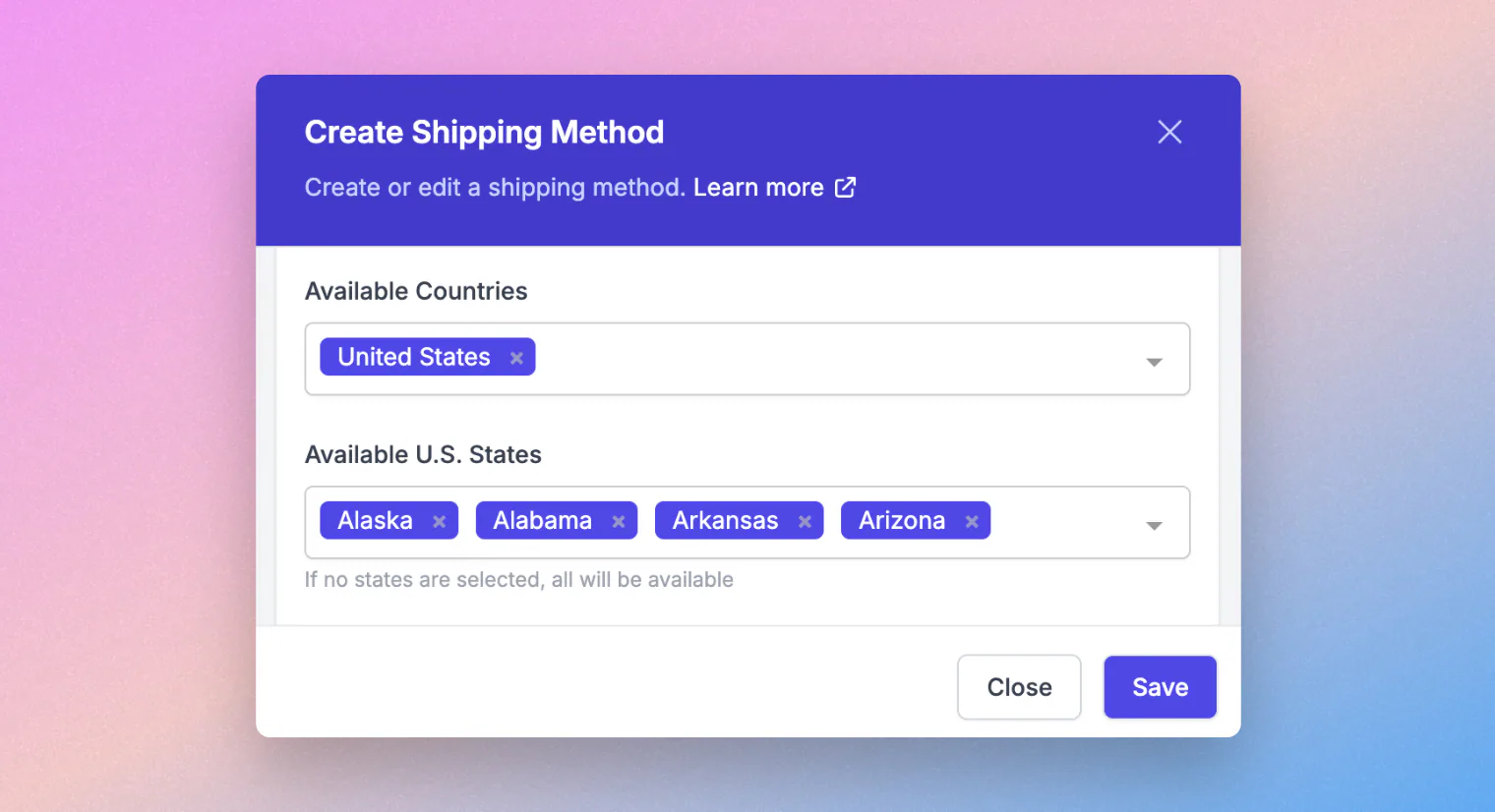
You can configure this directly under Settings → Shipping Methods.
Improvements
-
Quotes - CC Notifications to Child Company Users
Quote notifications sent to parent company users now CC child company users to keep both informed.
-
AI Cart Import - Support for Multiple SKU Columns
AI Cart Import now supports files with multiple SKU columns (e.g. vendor SKU and product SKU) and auto-detects the correct one.
-
Cart - Display Unit of Measure
Products with a single unit of measure now show it directly on the cart line item, without needing to hover.
Looking for older updates? Browse releases from June 2022 to September 2025 in the release archive.
Last updated